Saturday, 7 August 2010

Good Food and Chickens, too!

Let's see, how do I tell you about this next chapter of Austin? I'll have to delete a letter or two to not offend anyone, so here goes, Chapter 2 (with one more to come after this - Festival Hill Gardens and Royer's famous Chicken place).


I planned 2 surprises for Josh in Austin, arrangements I'd made in advance. One was a tour of downtown, the Capitol grounds, ghosts in a hotel, and the Mexican bats seen from the Congress Ave. Bridge via a Segway. The other was, Chicken S#!t Bingo at the Little Longhorn Saloon. Lucinda insisted a trip to Austin without Chicken S#!t Bingo, was no trip at all. (And how does all this relate to my garden, you may wonder? Just wait, it will).

It was hotter than blue blazes (100 degrees F.) in Austin and I admit I was having second thoughts about spending 2 1/2 hours standing on a Segway. But I was determined and Josh was excited at the idea. We arrived just before at Segway Nation on Lavaca St., just a block from the Capitol building (which, by the way, is the biggest capitol building in the nation...gotta love those Texans, they have to have everything the biggest, and tallest).

Chris Clary, General Manager, met us at the door and said there would be 8 or 9 in our group. As soon as the group was all assembled, Chris and his sidekick (Ryan, I believe), began giving everyone lessons on how to stand, move, turn and stop. About 5 minutes was long enough, then we had about 15 minutes of practice and made our first journey across a street to practice (driving?, weeling? Segwaying?) around the Capitol.

Then we were off, heading toward downtown via the sidewalks. At every stop light, Chris would halt the group, give some history of the spot and Ryan would block traffic when the light changed. We were like a flock of little ducklings, following our leader. I realize these guys do several of these tours a day with different groups, but they made it feel like it was the first time they'd done it, and seemed to enjoy it as much as we were. I highly recommend Segway Nation! It's the most fun I've had in years.


Sixth St. in Austin is the party street. It's lined with bars, restaurants and music venues. (Branson may want to be the music capitol of America, but Austin can prove it is). The sidewalks were crowded, the streets, as well. Lots of people park in lots many blocks away and take cabs or buses to spend the evening on 6th St. But we didn't hit a single pedestrian, nor did we ever have to get off the Segway. It was amazing how easy the Segway is to maneuver around people - and people who didn't know we were there because the Segway makes no noise, at all.


I quickly learned that a Segway is an amazing way to tour a city, visit a garden or go just about anywhere. Chris said the Segway can go up to 70 miles before it has to be recharged. It's balanced so you don't feel like you're always tipping over. In fact, it feels like the machine knows before you know what your mind wants it to do. (Walking, afterward, felt awkward and crude simply because riding the Segway felt like a vast improvement in feet and legs). We whizzed past restaurants, heard music, did a little obstacle course (that was great!) and made it in time to see the bats emerge, just at dark. There are an estimated one and a half million Mexican bats that live under the Congress St. Bridge, and they all emerge in one giant spiraling mass, delighting the lines of people already on the bridge, watching. So would I do the Segway again? In a heartbeat. If you go to Austin, it is absolutely the best way to see the city. That was Saturday night.


Sunday we drove over to Round Top, TX, and that story is in the next chapter, but first, Sunday afternoon and Chicken S*it Bingo at Ginny's Little Longhorn Saloon. Imagine a tiny Austin bar that's meant to hold about 50 people. Now fill it up with about 250 people. Then throw in a good band, and for toppers, put a table with a large chicken coop in the middle. And if you're thinking this is a drunken bunch of questionable people, it's not. It's families with kids, old folks, friends and neighbors, all gathered for the weekly Chicken Sh*t Bingo. And a lot of people just having weekend fun.

There was the band, whose name I've forgotten, but they were really good. Checking around the walls, I soon learned that a lot of well known bands and entertainers show up to play for Chicken Sh*t Bingo. Photos, autographs and band posters line the walls. This place is famous!


Lucinda danced, not with me, I have 3 left feet and no sense of rhythm. Her motto, "life is a fiesta" shows in her dancing.


But the main attraction was getting in line to nab a ticket for Bingo and that was no easy matter. The line was long, the ticket seller was in no hurry and neither Josh, Lucinda nor me, got a ticket. The goal is to buy a ticket with a number on it.


The number on your ticket corresponds to a square with a number on the floor of the chicken coop.


At the appointed hour, 4:00 p.m. I think, Ginny brings in the chicken. This is no ordinary chicken, this is a pet, a hen that has everything a hen could want. The lady could hardly get through the crowd because everyone was taking pictures of the chicken.


See the numbers in the blocks? And the floor of the cage is dusted with cracked corn. As I said, this is one well cared for hen. So the band plays, a few people dance, it's loud, hot and the music is excellent. Judges keep an eye on the hen and as soon as she poops, the crowd grows quiet while the number is determined, and announced. The winner takes home the purse from the sale of the tickets, usually about $250.


Our chickens, while certainly as well cared for as the hen at the Little Longhorn Saloon, can only wish for such fame and notoriety. They have to be satisfied with whiling away the afternoons in their own chicken pen. Our chickens play an important part in our garden. Their litter goes into the compost pile where it's processed into rich soil. The weedings from the beds, the vegetables that didn't get eaten, the left over bread or apples or fruit, all get added to the chicken yard where they happily gobble up every last morsel. (Their favorites are tomatoes and watermelon rinds). But happy chickens they are and it was fun to see how city chickens live in Austin.


And our best meal in Austin? Without a question, it was shrimp tacos and sprouted quinoa (pronounced keen-wa) Latin salad at the Snack Bar, 1224 S. Congress, next door to the Austin Motel (sorry, I don't have a clue how the salad was made, wish I did). The Snack Bar looks like a 1950s diner inside, and there's (very) casual outdoor seating where you can watch the people go by and enjoy some outstanding food. We passed it by for the locally famous Magnolia Cafe the first 2 nights, then tried Snack Bar. It's as good and fun as Magnolia's.


More food, great gardens to come!

Wednesday, 4 August 2010

Awesome Austin

Where do I begin? We only spent 2 days and 3 nights in Austin, but boy did we pack in a lot of fun and it will take at least 3 postings to do it justice (just a hint of what's coming...a funky, famous chicken place in Round Top, TX; Madalene Hill's gardens at Festival Hill, a trip to see Mexican bats on Segways, some great food, an afternoon watching chicken sh#et bingo, just for starters). And gardens all along the trail.
THANK YOU THANK YOU THANK YOU 
CHAD AND SUZY!!!!
Josh's niece and husband, Suzy and Chad, and their delightful 6 month old son, Liam, very generously offered to come and give us a weekend on our own. What sweet people and I am so grateful for their kindness. (Of course, letting Liam and Great Grandma Barbara get acquainted, was great, too!. They bonded immediately).

It's always a pleasure to see other people's gardens and one of our first stops was at our long time friend, Lucinda Hutson's garden. Austin's famous purple house, Lucinda's home, has been on my list of places to visit for years. I know the house from her books, from numerous articles in Southern Living and many more, but I had not actually seen the house myself. We've known each other for years but this was the first time to visit Lucinda at home. What a sweetheart she is!


Lucinda is, without a doubt, the most colorful, fun-loving person I know. From her house (inside and out) to her garden, her views on food and writing, this is one fun lady. Look at the pic, below. This is the back steps of her house. (Click on the picture to see the embellished cat door). Does your back door look that good? Ours certainly doesn't.


Lucinda is a landscape designer and has a perfect eye for decorating the outdoors, and in. Even the very flowers in her garden are seemingly beyond reality. Check out this one in her front yard (sorry, I don't remember what it is).

And this vine, below, which I wish I could grow here. Notice the top of the house is purple, the wall behind the vine, is yellow. Do you have the courage to use color that way? I wish I did.


Or this, a great Mexican bathtub set in her mermaid garden. When Southern Living came to do the photo shoot of her garden, they bashfully covered parts of the mermaid with a leaf. Above the grotto with the mermaid tub is another mermaid and lots of plants. It's a small garden and it would seem crowded were it not for Lucinda's eye for design. Instead of crowded, it unfolds like small rooms, each with fascinating features that invite you to keep moving forward to see more, and more beyond that. (I've had dreams like that, when sleeping on my Creative Dreams Dream Pillow).

Lucinda's garden rooms showcase a wide variety of plants, from cactus to vines, bloomers and lots of herbs. Herbs are everywhere and Lucinda and I share a love of herbs and food. She's known for her innovative cookbooks which you can see on her website.

That's Lucinda and Josh on her back patio, her very rustic-elegant writing office to the left where she creates her books, and a garden shed to the right. What a delightful visit we had and no photos can do Lucinda's garden justice. . More of Austin to come. But today, after weeks of dry, hot weather and dragging garden hoses around - we got rain!

Here's a recipe from Lucinda's Herb Garden Cookbook for Frijoles Negros en Olla (black beans in case you don't speak Spanish). A dish of lack beans is one of my favorite meals, over brown rice, topped with fresh salsa, diced avocados and a dash of hot sauce. Last year I grew black beans, aka frijoles negros, in the garden to see what they looked like in bloom.


1 pound dried black beans
Water or broth to cover to about 2 inches over the beans
3 T. olive oil or bacon fat
1 whole onion, quartered and studded with 2 whole cloves
4-6 garlic cloves
1/2 tsp. whole cumin seeds
1 bay leaf
1-2 whole dried chile peppers (ancho or pasilla)
Salt to taste
1 tsp. crumbled, dried Mexican oregano
3 sprigs fresh epazote - (epazote is known as "pig weed" in the Midwest), or substitute. Mexican mint marigold leaves


Wash beans well to remove dirt and any stones. Cover with cold water or broth, and remove any beans that float. Add oil, onion, garlic cumin and bay leaf and bring to a boil; immediately reduce heat and cover. Add chiles and cook for approximately 2 1/2 hours. If necessary, add more water to prevent beans from bursting. When almost tender, add salt, oregano and epazote. Uncover and cook another 15 minutes. When beans are tender the liquid should just barely cover them.

More gardens, more food to come!

Thursday, 29 July 2010

Butterflies

The night sounds in mid summer change noticably. Earlier, just about dark you could hear lots of frogs in the fish ponds. Now, it's the cicadas, tree frogs, occasional whip-poor-wills. Even if the sounds were recorded, one could tell by listening, just what the season is. You can also tell the season by what's in bloom and the butterflies that are visiting. Above, butterflies are enjoying their mid-morning nectar from the butterfly weed (Asclepias tuberosa).

The black swallowtail butterfly, also feeding on butterfly weed, is just one of dozens in my garden at present. Swallowtail larvae spend their time on parsley, dill and fennel, eating a leaf or two before pupating into the butterfly you see above. Can you believe it? Ignorant people actually spray these caterpillars to kill them!


Monarch butterflies lay their eggs on butterfly weed, or nearby. This one is enjoying life on my rue plant right next to the butterfly weed. Little does the caterpillar realize he, or she, will have to eat voraciously for the rest of the summer to prepare its strength for the long flight to South America before frost, then make it back in the spring in time to lay more eggs. (To see one very tired, pale monarch that barely made the trip last year, see my photo here).


Speaking of butterflies, Ann McCormick qualifies for that description. No, not a caterpillar, a monarch butterfly. She's a fellow-self publisher, following her passion for herbs and cooking and writing prolifically. Her very popular e-newsletter goes out to herbal enthusiasts across the blogosphere, and her tips, recipes and herbal ponderings are popular with her readers. You can read and follow her Seasonal Living newsletters here. Ann also writes a bi-monthly column for The Herb Quarterly magazine.


Ann has a new book, the 10 Must-Have Herbs for Cooks. It's chock full of her great recipes and lots of good information for growing and  harvesting herbs. Ann bills herself as the Herb'n Cowgirl and is a life-long Texas gardener. She lives in  Ft. Worth, which isn't the easiest place in the world to garden. 10 Must-Have Herbs for Cooks is available from Amazon, and at the link above.

Here's one of Ann's recipes for you to try. Dilly Potato Salad (in honor of dill, the Herb of the Year).

10 large red potatoes, quartered
1 1/2 cups fresh snow pea pods
3 stalks celery, chopped
4 green onions, thinly sliced
1 1/2 T. water
1/4 cup white wine vinegar
2 T vegetable oil
1 T. dried dill weed
1 T. sugar

Combine potatoes in water, bring to a boil, simmer until tender. Blanch snow peas in boiling water for 15 seconds. Drain and rinse immediately in chilled water.

In a small bowl combine the water, white wine vinegar, vegetable oil, dill and sugar, mixing well. Pour over the other ingredients, mixing lightly.  Chill at least an hour before serving. Very tasty!

We're off to Austin, TX, a city not far from Ann's hometown, to see what wonderful gardens we can find - it's one of my favorite cities. Details to come.

Monday, 26 July 2010

Red Noodle Bean


The red seeded Chinese noodle beans are producing like crazy. Every other day our 6 ft row produces 3-4 pounds of beans. That''s today's picking, above. Most beans average about 16 inches long.

I sometimes get a bit aggravated at hearing the same question from visitors to the garden, "But what do you do with them?" I resist raising my voice and saying - They are BEANS, think about it, what do you normally do with BEANS? But I don't. I just explain, they are BEANS, you cook them any way you cook any other green bean. They snap, with no strings, the large ones can be shelled if you choose, you can eat them in any size from 5 inches long (that's one day old) to 16-18 inches (that's a 3 day old bean). Boil, saute, steam, stir-fry or freeze, they are simply BEANS, and my favorite of all the beans I grow. They will keep producing right on to frost if I keep the beans picked. (You can order them from Territorial Seed, as well as Baker Creek Seed and others).

Not only is this an outstanding  bean, the flowers are attractive, as well. They bloom in pairs, which means there are always two beans per stem, which is handy for picking. As the flower wilts by the end of the day, it becomes almost blue instead of lavender.

Another bean I'm growing again this yesr is this one, above, which I've written about a few times before. It's a Seneca Bear Bean, a Native American heirloom bean, traditionally used when cooking bear. Since I don't cook bear, I like them cooked most any other way. They're a shelling bean, ready in the fall after they have dried. (For photos of the beans, go here).

I grow the Seneca beans on an arbor between two raised beds. It makes the beans easy to pick, plus shows off the attractive crimson flowers, which are in bloom  all summer long.

And here, the blossoms of Missouri Wonder pole bean. It grows next to the red seeded long beans, same amount of space, but the long beans outperform the Missouri Wonder beans by 100 to 1. It's an old, reliable heirloom variety, good for shelling beans primarily, but not a heavy producer most years in my garden. The flavor is beefy, hearty and worth the effort of growing it, however. The beans, shown below, are an old favorite from long ago.


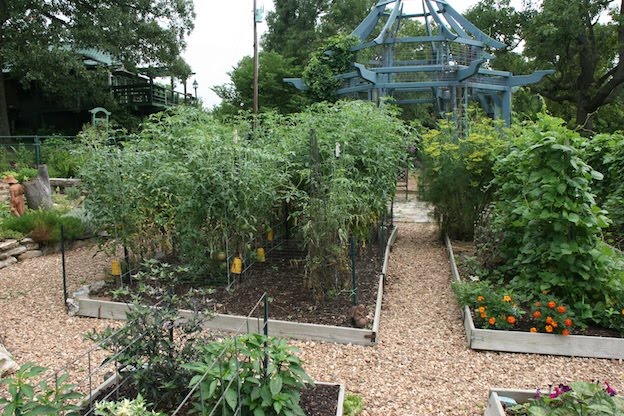
The garden today - bright sunlight makes it look dark. Click on the picture to enlarge it. You'll notice sheets and a picnic umbrella to the right - coverings for the tomatoes so they don't sunburn. Stay cool if you can.

Friday, 16 July 2010

A Garden Tour

 Above is the Herb Shop with bell tower and tiny viewing deck, above.

Sometimes all the planets align, the weather cooperates and the garden grows. Yes, there are weeds, especially a variety of so-called spurge. But otherwise, a few bugs, too much rain and a lot of heat and humidity, are only small issues, I want to give you a tour of this summer's garden. Thanks to a lot of work from  Adam, Josh, me and The Fates, it is a GOOD garden.

There are two blue gates that you can enter through. This one (above) has a series of bells as weights, to make it self-closing. On the left of the gate is the red-leaf hibiscus (Hibiscus acetosella) and overhead is the grape arbor with wild grapes and muscadines.

If you climb the bell tower above the Herb Shop and look down on the garden, this is what you will see, a partial layout of the garden beds. If you look us up on GoogleEarth, this is also the view but from directly above, via satellite.

Looking over to the right (east, toward the Long Creek arm of Table Rock Lake) you'll see the old barn where the goats and chickens live, the garden shed and the little water garden.

Native medicinal plants are on the left, some of the culinaries on the right (grape arbor straight ahead, blue gate on the right).

Notice there are trellises along the fence on the left. Pathways are gravel and wheelchair accessible.

Edible flowers bed with grape arbor in the background. The early blush of roses are over, the Japanese beetles devastated the flowers but they're about done with, and the roses will be back in bloom, shortly.

A garden angel resting on the rock wall next to the chives and Mexican mint marigold (Tagetes lucida).

You can't see the goldfish pond in the middle, but this is the bed that Bessie, the box turtle has been coming back to for the past 28 years to lay her eggs. The gazebo is in the background, which has a variety of vines growing upward.

Ahead is the Myoga ginger bed behind the bench. To the right is a bed of all salvias and the lengthwise bed to the right is mostly lavender.

I'm growing 17 varieties of hot and super-hot chilies this year. No, that's not an outhouse in the background. It was once a ticket booth for the Boone County, AR Fair. I rescued it from a ditch and it serves now as housing for stacks of plant flats, pots, row covers, and an occasional pack rat, which Molly removes promptly.

The tomatoes are in the old sweet corn bed. Lots of new research shows that corn leaves beneficial bacteria that tomatoes avoid some fungal problems.  To the right is the row of Potawatamie bear beans, a Native American variety. You can barely see the deck of the house in the upper left corner. It looks down upon the garden in a nice view.

This is a statue I like because it reminds me of the late Adelma Simmons of Capriliands Herb Farm near Coventry, Connecticut.

An especially elegant white althea grows just outside the kitchen door.

Well, there you have it, a tour of some of our gardens at Long Creek Herb Farm. We launched our new website this week. If you have old bookmarks to my books or products, they won't still work. But the web address http://www.longcreekherbs.com does work, that address has not changed. Now, when you go there, in order to place an order you have to create an account and sign in, with a password of your choosing. It's an additional step for security, as well as obeying new rules for web businesses beginning the first of July. It's an added bit of security that will help over-all, although our customers tell us it's frustrating in the beginning. (You may recall that in the past we have had no safe way to keep credit card numbers on file for extended periods, so our method has been to ask for it each time, then shred the orders afterward. The shreddings go into either the garden compost, or as nesting material for the chickens. Either way, it was safe, but this new method complies with all the regulations for web businesses. But we'll still be shredding and composting customer information, just like before.

Check out the new website, and forgive the parts that still need attention. I think you'll find more to see and do, including pictures of the goats, garden, and more. Happy gardening!

Monday, 5 July 2010

Red, White & Blue Potatoes

The 4th of July marks my favorite of all holidays. Better'n Christmas (no cards, no guilt about presents, no big commercial hoopla). Better than New Year's because it too cold then. No, the Fourth of July, Independence Day, is just right. Hot weather, good food, fireworks. Oh, did I mention fireworks? What other holiday do you get to make a lot of noise and shoot rockets into the night air? And it's my friend, George's birthday. Plenty of things to celebrate.

As a kid I sold fireworks from the front porch of my parents' grocery store, making enough money to shoot off a few bangers myself, but mostly to squirrel away the profits toward some bit of technology or other.

Yesterday Josh and I dug the potato crop. You may recall the potatoes I planted this year were the Best Blooming Potato collection from Wood Prairie Farm. I planted the potatoes later than I like,  an entire month later, so they had a few potato bugs. But the plants bloomed pretty well and so on the 4th of July, the potato crop was ready to dig. We got some big, pound-sized potatoes but most were medium and small, just what I like. It seemed appropriate to have red, white and blue potatoes on the holiday.
 Here are a few of the potatoes in the gathering basket, along with the first picking of red-seeded Chinese long beans, which I pick anywhere from 8 inches long to 16 inches. There is a handful of purple royalty green beans, too, but like every year, those have a worm in the bean every now and then. And those beans have to be stringed. I'm going to pull those up and plant something else. But the 6 ft long row of Chinese long beans put out about 3 pounds of beans every 3-4 days, way more than we can use, so I'll start leaving them on the neighbor's doorsteps. Out of the 7 bean varieties I'm growing this year, Chinese long beans are far and away the best green bean variety. I cooked the beans, potatoes, shallots and onions together with some bacon and ham, just like my Mom used to do.

Josh took off today on a 2 day book tour across Missouri. He's visiting some of the characters in his book and delivering copies to the ones who made it on the cover. In Missouri Curiosities, Third Edition (Globe Pequot, 2010) he has once again divided the state into regions, then ferreted out all of the quirky roadside attractions, out of the way weird sculptures (and sculptors), unusual diners, strange water towers, bizarre museums, and a whole lot more. Did you know there's a Hair Museum in Independence, MO? How about the World's Largest Pecan, in Brunswick? Or the restaurant in Branson that advertised, "Pie ala mode, $250; Pie ala mode with ice cream, $3." (Really, it's true, I used to eat there).


Josh's book is full of his on the mark humor, and this, his third edition of Missouri Curiosities is the most up to date guide to day trips and car excursions anywhere in the state. Even if you don't live in or visit Missouri, it's a fun read. (Josh has won 3 national awards for his newspaper humor columns and with a name like Josh, you know he's full of good humor). If you are interested in your own copy of the book, contact him and he'll be glad to autograph it for you when you order.

Remember my writing a few weeks ago that Matthew from the Amish Country Store in Branson brought bees to reside on the farm this year some time back? Here's one of them, the happy Italian bee, hard at work gathering nectar from a drum-stick allium flower. And, no, the honey won't taste like onion. The blossoms of this variety are sweet scented and bloom over a several week period. The bee is obviously doing it's job and we certainly are having good pollination on everything this year. Happy 4th, 5th and everyday in July. Garden season is the best of all seasons!