Sunday, 3 April 2011

Arp Rosemary, the Real Story

Arp and Hill Hardy rosemary

I've long wondered how 'Arp' rosemary got its name, and I admit I always thought it an odd choice for a plant name. While visiting Festival Hill a couple of weeks ago, I was pleased to share breakfast with Gwen Barclay and Henry Flowers. Gwen, as many of you remember, is the daughter of the late Madalene Hill (whose incredible rosemary collection resides at Festival Hill). Henry Flowers it the horticulturalist and over-all plant genius at Festival Hill and began his work under Madalene's supervision. (If you want to know more, you can read the tribute I wrote about Madalene on my earlier blog, here.
Henry Flowers, Horticulturist at Festival Hill

Gwen Barclay, chef, musician and herbalist.

Gwen made a reference to Arp rosemary, how there were a lot of the plants sold during the plant sale that weekend and that the Herb Society of America was intending to plant a commemorative plaque in Arp.

"You mean Arp is a place?" I asked.

So I got the whole story, directly from Gwen and Henry. Gwen and her mother have cousins in Arp, Texas, southeast of Tyler. One Christmas they were visiting their cousins and Madalene noticed a very robust rosemary, in full bloom, in front of an abandoned house nearby. It was unusual for a rosemary to be covered with blue-lavender flowers at Christmas time. Madalene inquired of her cousins and the neighbors if anyone knew who owned the old, neglected (and empty) house. No one knew anything about the owner.

Madalene borrowed a knife and made several cuttings from the very prolific rosemary and took them home with her to root. Over the next few years she shared the cuttings with several people, including the late Tom DeBaggio. He began propagating the now named, 'Arp' rosemary for his retail nursery. (You can read more about Tom and his amazing story of dealing with Alzheimer's disease on his nursery website here; you will also find lots of stories about him on National Public Radio, the Washington Post, etc. if you Google his name).

Hill Hardy rosemary

One day Tom noticed that one rosemary stood out as different from among the dozens of trays of Arp rosemary cuttings and he separated it out and grew it on, propagating more. That rosemary was more gray and fine-leafed than the Arp rosemary which appeared to be its parent. Over time Tom discovered the grayer rosemary to be equally or even more hardy than the original Arp, and he dubbed it, 'Hill's Hardy' rosemary, in honor of Madalene Hill who had first brought it to him.

Thanks to my Garmin navigator, Arp wasn't difficult to find.

Since I had Arp rosemary with me, and now knew the real story of the origins of both these exceptional rosemaries, and since I was already heading toward Tyler, TX from Round Top/Festival Hill, I decided I should definitely drive to Arp, TX and see where this amazing rosemary came from.
That's my pot of 'Arp' rosemary, standing proudly in front of the Arp welcome sign.

(Madalene had found, in later years, the name of owner of the property, and learned the rosemary had come to Arp from "somewhere up in Oklahoma," but no one knew anything else about its origins). The Herb Society of America is slated to erect the plaque in Arp, sometime this coming summer.

That's 'Arp' on the left, 'Hill Hardy' on the right. Some nurseries list 'Hill Hardy' as 'Hill's Hardy' rosemary, which I believe is correct. Both are outstanding rosemaries to grow and use.
 So there is the story of the origins of a this particularly good, and hardy rosemary and it's cousin, 'Hill Hardy.' The rosemary itself is likely more famous than the little town it came from, but you can't miss the sign if you drive through.

Wednesday, 30 March 2011

Fun Stuff in the Garden

Gardeners shouldn't take themselves too serious. True, the garden is about food, but it's also about enjoyment. Following here are some fun things I've found in other people's gardens and I'm hoping you might get an idea or find some inspiration. I know I have - I just can't find spaces for all of these ideas!
Balancing stones is an ancient art. You have to use trial and error to find the right spot for the balance.
Built on metal supports the flowerpots in this sculpture are quite large and heavy.

Here's something to do with all your extra flower pots. Flowerpot guy stands at a nursery north of Tyler, TX.
Another very cool thing to do with your extra flowerpots! This is an arch on the grounds of the Antique Rose Emporium, outside Brenham, TX. The pots are strung on heavy wires and wrapped around a metal support. Notice the "bells" at the top of the arch.
How about these in your garden? Round Top, TX, where I visited last week, is the site for a twice yearly antique festival. Tents full of things like this, which aren't antique, but tempting, stretch on for 10 miles or more. How about one of those on each side of your garden gate? Even one of the steers, behind the horses, would look good in a garden.
Or how about a purple fence with an orange cat?
These are stunning rose supports for climbing roses. They are on the grounds of the Antique Rose Emporium.
Happy roosters always look good in the garden.
If you look close, this rooster is made from car bumpers and chrome car parts.
But no matter where you go, or what you see in someone else's garden, nothing is quite as peaceful and inspirational as a quiet little frog who believes his current color makes him invisible.

Happy gardening!

Wednesday, 23 March 2011

Herbal Forum, Festival Hill, Ginger Beet Cake

I love springtime and I've gotten to see it from cold to hot in just days. From Michigan to Ohio, in moderate but still winterish weather, I drove south to home, where spring was showing, but just a little. Unpacked, repacked, I drove to Texas where spring is truly in full gear. Everywhere I drove, the wisterias were in bloom and the air was filled with the fragrance. I don't think I've paid much attention to wisteria fragrance before, but it was really pleasant. Every town, every roadside, had wisteria sprangling through the trees, over fences and looking like lavender lace over rooftops.
This was the 16th annual Herbal Forum at Festival Hill, at Round Top, Texas. It's held on the grounds where the late Madalene Hill's gardens are located. Several of us took advantage of the full moon and walked through Madalene's gardens by moonlight. What a treat! I thought several times I heard her say to look at this plant or that.
The first part of Madalene's garden and it only gets better from here!
The Pioneer Unit of the Herb Society of America sponsors a plant sale at the Forum each year. The last time I was a speaker there (1997) the plant sale was a little affair. Not any more! There must have been several hundred people from the surrounding area, and not all of them attending the Forum, lined up at 7:30 a.m. the first day. And more on the second day. It was a madhouse of plant sales!
One side of the plant sale (it's huge!) on the second day after things had calmed down.
Same spot, looking the opposite direction. There was way, way more behind the tents. Henry Flowers had used my list of plants from my, "New Herbs to Grow" program to order for the sale, along with many, many, many more tempting herbs of all kinds. I bought 3 flats of plants plus a box or two, as well.
This was our lodging for the speakers. The dining room is downstairs, where the chef was the private chef for Dean Martin. We ate well! If you could look to the right of the house, you would see the view of Madalene's garden (as seen a few pictures above).
The Concert Hall, where famous musicians from all over the world perform, was the setting for all of our lectures, demonstrations and programs. If you click on it to enlarge the photo, you'll see lighted balconies surrounding the Hall.

Like all herb events, food was a big part of the Herbal Forum. Lots of demonstrations, tastes and great meals.
One of our meals was served on the patio behind the big Victorian house. It was in the mid 80s, so lots of folks headed for the shade. This shows about a third of the entire group who were signed up for the event. I gave 2 of my "Less Stress, Better Sleep" workshops as well as the new plants program.
One of the stars of the big outdoor lunch was this Ginger Beet Cake. It was outstanding and I made it for our after dinner dessert tonight. It is really good! Thanks to the chef and the folks at Round Top for the recipe.
Ginger Beet Cake
1 15 oz. can of beets (not pickled, just canned beets)
1 1/2 cups flour
2/3 cup vegetable oil
3 eggs, beaten
2 cups sugar (I substituted 1 1/2 cups granulated stevia and 1/2 cup sugar)
2 teaspoons cinnamon
2 teaspoons dry ginger
2 Tablespoons fresh grated ginger
2 teaspoons baking soda
1/2 teaspoon salt
1 cup nuts, chopped (I used pecans)
3/4 cup coconut

Heat oven to 350 degrees F.
In a food processor, empty the entire can of beets, juice and all. Blend it up well (I then added the nuts and chopped them). Combine the rest of the ingredients, mixing well. Pour into a 9 x 13, oiled and floured baking pan. Bake until a knife inserted comes out clean, about 25-30 minutes. Let cool. Serve with real whipped cream. People were going back for seconds, saying this couldn't possibly have beets in it.
Ginger Beet Cake, moist, delicious and no, it doesn't have any chocolate in it (but you could probably add some!)
It was a lot of driving, a lot of work, but it was great seeing old friends and making new ones. Thank you to all who bought my books and said nice things about my workshops and programs! It was great seeing Texas in the springtime.

Monday, 14 March 2011

A Week of Bentwood and Horseradish (and Fish Fries)

Display at the front of the room where the speakers lectured.

This was my first visit back to the Michigan Herb Associates since 1997 and it was fun seeing lots of old friends and making new ones. I was pleasantly surprised to find lots of earth showing between the patches of snow, and it only snowed about 2 inches while we were there. I'd expected it to be like upstate New York, with 6 feet of snow on the ground and no bare earth showing for another 2 months. Instead, it was 40-ish degrees each day, down to almost freezing at night, and a spot of sunshine one afternoon.
This is the herb garden at the Toledo Botanic Garden when I spoke to the Maumee Valley Herb Society.

Like most herb conferences, the MHA conference revolves around food. We had cooking demonstrations, a snack table each day of made-from-home herb foods, book sales, silent auctions, vendors and nice meals in the hotel each day. Most herb folks grow herbs because they like to eat, and herb events, no matter how large or small, make food the centerpiece.


One of the food demonstrations was given by Connie, who demonstrated salads, hors d'oeruvres, dips, cheese balls, soups and desserts. Then people lined up to have a taste.

The tablecloth makes these foods look a bit messy, but they were actually beautiful. There's a chicken salad stuffed into the red lily (edible lily) and a raspberry, greens and goat cheese salad in the yellow edible lily.
 It was fun to see Theresa Mieseler from Shady Acres Herb Farm. We served on the Board of Directors for the International Herb Association some years back. Lots of long time friends were there, too, so we got to visit with lots of folks we don't get to see often.

I gave 2 programs, Making Bentwood Trellises and Cutting Edge Plants and both were well received. The MHA folks were a great and generous audience and I always draw energy from such good groups. The bentwood trellis I made in the demonstration was given by my friend, Jon Hoffman (who had been one of my "wounded" Civil War soldiers back in 1997) and was auctioned off to benefit the 4-H Childrens' Garden in East Lansing, where the conference was held. (The Conference was on the campus of Michigan State University, home of the Spartans. We had great fun reading over the signs on campus like, "Enjoy our Spartan Hospitality" which no else seemed to think was funny. Spartan, sparse, it made us laugh).
Connie's great looking food samples had everyone excited.
Horseradish was the featured herb, since it's the Herb of the Year in 2011. Chuck Voigt, who has been the chair of the Herb of the Year committee for the International Herb Association for the past several years, made it his goal to see horseradish recognized. He's a professor at Illinois State Univ. and consults with the horseradish growers in his state. In case you don't know, Illinois is the leader in U.S. horseradish production. You can find more information about this Herb of the Year on the IHA website, as well as on the Herb Society of America's website and on my Herb of the Year blog. We dubbed Chuck, "Mr. Horseradish" some time back and his program, "More Than You Ever Wanted to Know About Horseradish" was outstanding.
Dr. Chuck Voigt is the Principal Research Specialist at the University of Illinois, Urbana, Ilinois and a promoter of horseradish. He's been a tireless worker with the Herb of the Year project for many years.
Add caption

I helped auction off the bentwood trellis, then I was off to the Maumee Valley Herb Society for 2 programs at the Toledo Botanic Garden. Those folks, too, like herb food, and had a buffet table of cookies, cakes and other tasty desserts.

My hosts, Mark and Georgeann Brown, treated Josh and me to our first-ever, Catholic fish fry. (You may recall, I tried to buy fish in a pub in Madison, WI last spring, but it was Wednesday and no fish was to be had). Well, the tradition in the northlands, is, fish is a Friday food. During Lent, all of the Catholic churches have fish fries on Friday nights.

Our friends took us out for fish fry dinner and we were not disappointed. You pay at the door, told to get in line (get there early, the lines can be long) and folks on the other side of the service window pile your plate with perch and shrimp, along with scalloped potatoes, green beans and coleslaw. You can go back as many times as you want (3 for me, 2 for Josh) and there's desserts to choose from, as well.
The perch is from the Great Lakes and quite tasty. It reminded me of the suckers, a local fish here in the Ozarks, that are the feature of Sucker Day Festivals in the summer.
The herb gardens at the Toledo Botanic Garden are tended by the members of the Maumee Valley Herb Club and even though I couldn't see the plants because of the snow, the bones of the gardens were beautiful. I like to see the architecture without the plants, it makes it easy to see the shapes and forms of a garden.
The blue bench in an otherwise black and white world was a nice addition to the garden. It's a memorial to a long time member of the Maumee Ohio Herb group.
These are espaliered fruit trees along the back fences of the herb garden.
Our trip to Michigan and Ohio were enjoyable and we survived the cold. Wednesday I'm heading to Austin, TX where you may remember I found lots of fun stuff last fall (you can look through previous blog posts to see our adventures). I'm speaking at the Roundtop Festival Institute and you can see the gardens there if you follow this link. The redbuds are in bloom already and spring will have arrived by the time I arrive in a couple of days. They may even have some Catholic Church fish fries, who knows. Happy gardening!

Wednesday, 9 March 2011

Michigan Herb Associates

In Michigan for the Michigan Herb Associates annual conference. Today was my bentwood trellis program, tomorrow I'll give "Cutting Edge Plants" then on to Toledo, Ohio for "Eat Your Landscape" program.

I dreaded all the snow up north, but it's actually bare ground in some places and above freezing. Not too bad. Next week, Austin, TX for some warm weather. Photos to follow in a day or two.

Monday, 28 February 2011

More on the Kids' Garden

Melinda Smith, garden coordinator is explaining to Olee how the beds will be realigned.
My friend Olee Jobe, from Spring Fever Greenhouse in Republic, Missouri and I, drove down to Jonesboro, Arkansas a few days back. Olee had not seen the kids' garden and was interested, and he was donating potting soil and pots for their greenhouse. He was as inspired and impressed as I had thought he would be. It was a 4 hour drive for us each way to make the delivery, and well worth the trip.

Melinda was explaining the work in the garden coming up this week. The beds, currently done at an angle, (which she said looked like a good idea at the time 2 years ago) were going to be straightened. A local nursery is coming to realign the beds and add 2 additional ones, as well as put paving blocks around the beds to help keep the Bermuda grass somewhat at bay.
These are the beds that will be aligned along the pathway to make room for 2 more beds.
Pansies are in bloom in one of the beds and tulips are coming up in another. The nursery folks will transplant the bulbs, so nothing is lost. With the work progressing this week, the kids will be able to start planting some of the seed Renee's Garden Seed have donated.
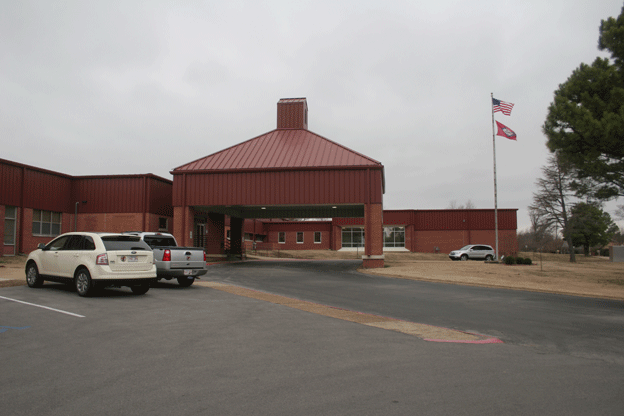
This is the entrance to the school. Some of you have asked to see what it looks like. Melinda Smith said they have about 600 students in grades 1-6.
This is one corner of the science lab. In another corner there are several lizards, a snake, some birds, fish, plants and lots of books. I think Olee and I could have enjoyed sitting in class if we'd had such an interesting school room!
Several of the teachers stopped and thanked us for taking an interest in the kids' garden project. It was fun to see how the kids reacted to the teachers. I saw kids on numerous occasions come up and hug a teacher and say thank you for something. Olee said, and I heartily agreed, if we had ever had a teacher in our past who would hug a kid, we might have actually liked school when we were that age!
This is a recyle-robot. One of the classes had a contest with the kids to see what kind of projects they could come up, using all recycled materials. This was the winner. He's about 5 ft. tall, made totally of plastic bottles, milk cartons and similar materials. 
Would you like to help this amazing school? Here's a really simple, and totally painless way. Our friend, Renee Shepherd, owner of Renees.com (Renee's Garden Seeds), is making a wonderful offer. If you go to her website and order seed, and use this code when you order: FR556A, she will donate 25% of the price of the seed you order, to the Jonesboro School to Kitchen Garden Program. Isn't that great? So, go to her website and order some seed, being sure to use the FR556A coupon code.

We have been fans of Renee's seed collections for years. I love her selections of salad greens, squashes and herbs. She also offers something I really like, which is combining several varieties together. Like her Summer Scallop Trio, for example, which has 3 different colors of patty pan squashes in a packet, that way you don't have to buy several packets just to get 2 or 3 plants! And she tests her varieties first and only offers vegetables and herbs that will perform really well in your garden. She has very generously donated seed for the kids' garden this year and the kids and teachers will be planting in a few days. Meanwhile, order some seed for your garden and know you are also helping out this wonderful kids' garden project! (You can also go to our website and order from the link on our home page, using the same coupon code).

You can also follow the kids garden blog by going here.

I'm off to the Michigan Herb Associates annual conference, starting driving this weekend to give programs on March 9-10, then on to Toronto (Michigan or Ohio, I'm not sure) for programs on the 11th, driving home in time to repack and drive to Roundtop, Texas to speak at the annual Herbal Forum at Festival Hill (look at the link, you'll be impressed at the photos of this amazing garden!!) I'll be driving from the upper reaches of Michigan where it's going to be COOOOLD, then head south to sunny Texas where spring is already well underway.
Happy gardening!

Sunday, 20 February 2011

Jonesboro, AR Kids Garden

Those of you who have known me for any period of time will likely remember how excited I get when I hear about garden projects for schools. Several will remember, too, that I attended the very first Slow Foods conference in Turin, Italy, in 2005 and how pumped up I was for the entire slow foods, local foods movement, and remain so today. Food safety, including knowing what pesticides and chemicals we are putting into our bodies, is important. So is seeing that the money we spend on food goes to our neighbors and local community instead of to some giant corporation elsewhere. Add that to the fact that what you grow tastes better, costs less, and is better for you, then the local foods, school gardens projects make really good sense.
Outdoor demonstration area with part of the second garden in background
A couple of months back Melinda Smith from the Health, Wellness and Environmental Studies Magnet School, in Jonesboro, Arkansas contacted me, asking for suggestions about adding an herb garden to their school garden project. I was pleased to be asked and have more ideas than good sense.
Photos on the wall of last year's produce.
 I admit I was startled to find a school in Arkansas with a kids garden project. I love Arkansas, it's one of the best kept secrets in America (if everyone knew how beautiful the state is, there would be a lot more people and it would lose its attraction). But anyone who knows Arkansas, also knows it is not on the cutting edge of much of anything, especially not forward-thinking school projects devoted to health and wellness.
You can see the 10 raised beds (surrounded with awful Bermuda grass) and the little greenhouse in the background.
I had visited an amazing school garden project last summer in Dallas, and posted about it here. And I posted about the amazing Waldorf School outside Chicago this past fall. I've posted in past years about the kids garden projects in San Antonio and Philadelphia, too. But I was pleasantly surprised to find a school in eastern Arkansas with the foresight and creativity to be teaching kids about where their food comes from. I had to go see this school project!
That's Melinda Smith, Coordinator of the project, in the wonderful teaching kitchen.
Melinda Smith is the coordinator of the project, and she's one of those people who will not take no for an answer. Even when confronted with "that's impossible" she forges ahead and gathers people around her who can see a project move forward. She's received all of the questions about the project one might hear in any rural area, things like, "What's wrong with pizza and tater tots for school lunch?" "Why do kids need to learn to grow their own food?" and "Aren't there more important lessons than food?"
This is the trellis bed in the second garden area. The children grew vine plants last season.
Fortunately Melinda has a group of interested fellow-teachers who are dedicated to teaching children about health and wellness and realizing the food they eat has a profound bearing on every other aspect of their lives, including how they learn, how they grow and what they become.
This is part of the second courtyard, trellis garden in background. There are a few raised beds and lots and lots of Bermuda.
In an age when a high percentage of the population is overweight, and with a generation of people who think cooking from scratch involves opening a package for the microwave, the Health and Wellness Magnate School is a breath of fresh air.
One garden has chickens. The kids learn about where eggs come from and how to care for animals.
In only 2 short years, this unique Jonesboro school has generated enough grants to pay for several raised beds, a very small greenhouse and some seed, in previous years. They've used up the money and have spent it well. In spite of having to deal with an enclosed courtyard that is infested with the deadly Bermuda grass (deadly because it is so tenacious it comes up through plastic or paving - I've even seen it find its way through asphalt!) the kids held their first plant sale last year with plants they'd grown in the greenhouse. They produced vegetables and greens which they used in the impressive teaching kitchen lab.
Two homeless rabbits were given to the school and they are at home in one of the courtyards. Remember how Peter Rabbit's mother gave him chamomile tea when Peter ate too many carrots from father McGreggor's garden? These rabbits are well behaved and the children love them.
Renee Shepherd selects some of the best performing herbs and vegetables anywhere.
This year, the teachers want to move this garden ahead. Our friend, Renee Shepherd of Renees Garden has generously donated lots of seed for their beds and greenhouse. (If you don't know Renees' Seed, check out the link; she has some of the best mixtures of seeds, always outstanding performers in our gardens here). Our friends, Olee and Sharon Jobe at Spring Fever Greenhouse have donated several bags of potting soil and pots for the greenhouse.
One of the courtyards (there are 2) includes a raised bed with bulbs and roses.

The garden has its own blog where the teachers and kids post photos and updates on their garden. I urge you to go check it out, and sign up to Follow. (It's free, you don't have to do anything, just receive a note when they post new information, it's a great way to show your support). This is a project that has had a lot of "no" answers when they've asked for help. Many in their local community have been less than sympathetic or encouraging, so sign up as a follower and let them know you support what they are doing. I'll be posting more soon, but I wanted you to know about this really great garden project for kids.
Both the kids and the teachers made little flags with quotations they like, to decorate the outdoor demonstration area.
Keep in mind all these photos were taken in January but you can see the basics and by spring, this is going to be a beautiful garden again.
Happy gardening!